
Lockout/Tagout (LOTO) Safety Compliance — UX Research, Kiewit Technology Group
Research identifying critical gaps in a high-stakes safety compliance process — informing a solution that improved efficiency by 30% and projected $300,000 in annual savings.
Transforming high-stakes safety procedures through user-centered research
Safety compliance in high-risk environments requires workers to follow precise procedures under time pressure and cognitive load. How do we design for error prevention when mistakes have life-or-death consequences?
Behavioral Challenge
Conducted interviews with safety personnel and secondary research on current standard operating procedures (SOPs) to understand compliance barriers, memorization challenges, and real-world deviations from documented procedures.
Research Approach
Designing for safety-critical tasks, such as reducing errors through thoughtful UX, supporting compliance under stress, balancing speed with accuracy, applies from healthcare protocols to financial trading systems.
Transferable Insights
The Product: A digital transformation of the Lock Out, Tag Out (LOTO) process—a highly regulated safety procedure critical for de-energizing equipment during construction maintenance. This project tackled the inefficiencies of traditional paper-based LOTO, aiming to digitize the workflow without compromising safety or compliance.
My Role: Lead UX Researcher—conducted end-to-end research for a safety-critical digitization project. Designed and executed interviews with 6 LOTO specialists to understand current workflows and compliance barriers, facilitated usability testing with 5 specialists on high-fidelity prototypes, and translated research findings into specific design requirements for a mobile-first safety compliance system. Advocated for user-centered design in a high-stakes environment where errors have life-or-death consequences
Key Outcome: 30% increase in permit handling efficiency, improved compliance, enhanced user satisfaction, and an estimated $300K saved annually in fines, administrative costs, and avoided downtime.
Industry: Industrial Safety / Construction Tech / Enterprise Workflow
Team: UX Research (Me), UI Designer, Stakeholders
Constraints: Stakeholder buy-in, balancing safety & innovation, technical integration, regulatory compliance, scope management
Project Snapshot
💡 Research Impact: When Design Mistakes Have Life-or-Death Consequences
LOTO procedures prevent workers from being killed or seriously injured by unexpected equipment energization during maintenance. Manual paper-based systems were error-prone: delays in authorization, lost paperwork, and communication gaps created compliance risks and potential OSHA violations.
Without research to understand the cognitive load LOTO specialists face under time pressure, the digital solution could have introduced new friction points that actually decreased compliance—making the workplace less safe, not more. This research ensured the solution reduced errors while maintaining strict regulatory adherence, resulting in 30% efficiency improvement and an estimated $300K in annual savings from reduced incidents, fines, and administrative burden.
The Challenge
Manual Process, High Stakes
The traditional paper-based LOTO system was fraught with inefficiencies, manual errors, and communication gaps. Complex documentation, labor-intensive coordination, and frequent "temporary lifts" for testing created bottlenecks and increased the risk of non-compliance and safety incidents.
Critical Pain Points:
Project Engineers spending excessive time on error correction
Potential financial losses from inefficiencies
Reduced focus on critical safety responsibilities
High risk of non-compliance with OSHA standards
The Solution
Digitalizing for Safety & Efficiency
Our solution digitalized the entire LOTO process to streamline authorization, improve record-keeping, and facilitate seamless communication.
Goals:
Enhance Safety & Compliance: Reduce manual errors and ensure adherence to OSHA 29 CFR 1910.147
Boost Operational Efficiency: Streamline workflows, reduce administrative burden, eliminate bottlenecks
Improve User Experience: Create an intuitive system that empowers LOTO specialists to focus on safety, not paperwork
Research Process
Discovery: Understanding the Existing Process
Methodology:
Desk Research: Reviewed existing Lockout/Tagout Programs and OSHA compliance standards (29 CFR 1910.147) to understand regulatory requirements and company policies
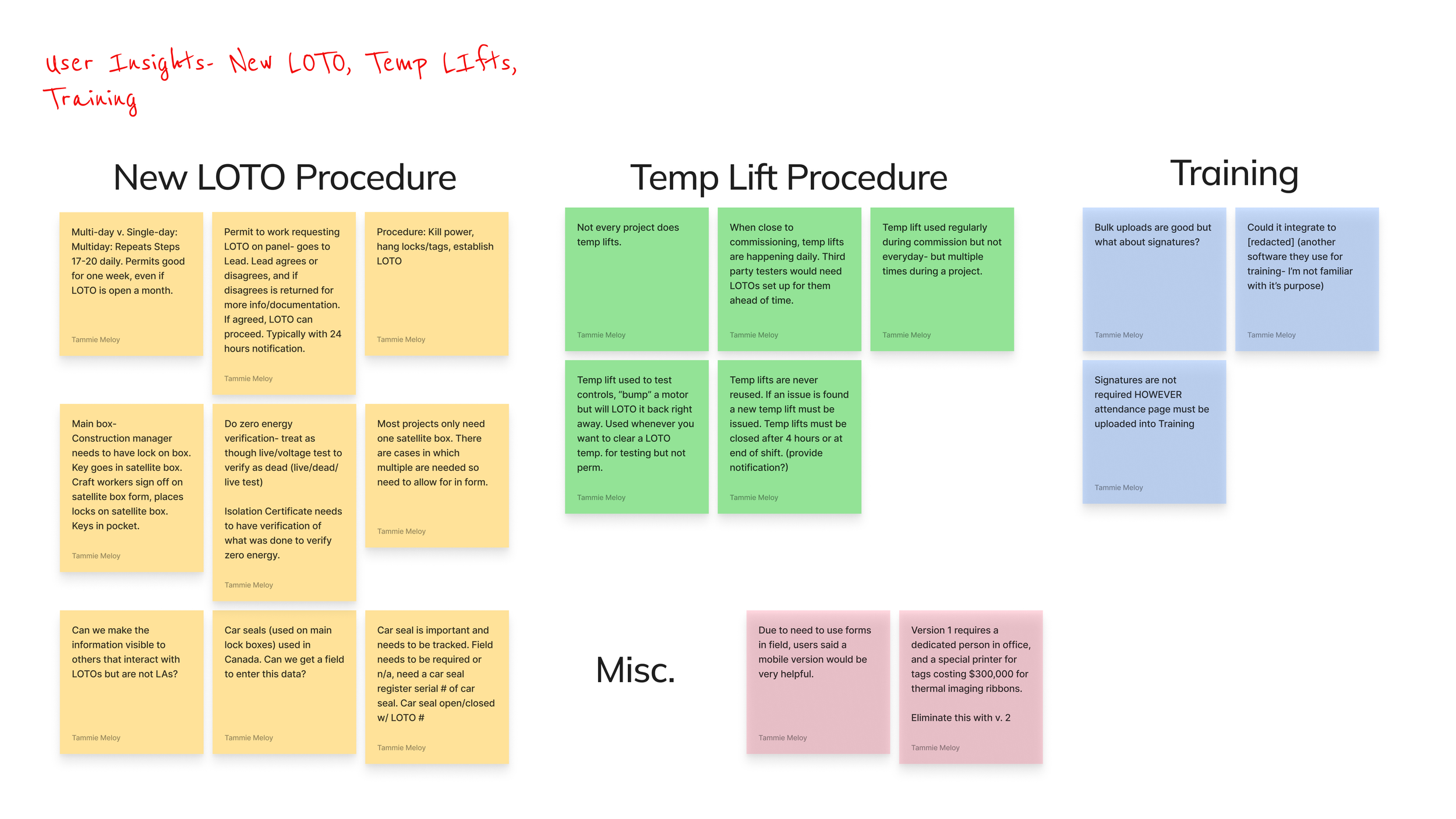
User Interviews (N=6): Conducted in-depth interviews with LOTO specialists to gather first-hand insights on current workflows, daily tasks, pain points, and challenges
Key Research Insights:
Complexity: LOTO procedure was far more intricate and multi-step than initially perceived
Manual Documentation: Paper forms were time-consuming, error-prone, and difficult to track/update
"Temporary Lift" Bottlenecks: Frequent temporary lifts required repetitive authorization, documentation, and notification steps, creating significant delays
Coordination Challenges: Delays in notifying personnel about LOTO status changes and ensuring clear client communication
Compliance Risk: Manual processes increased risk of non-compliance, fines, and safety incidents
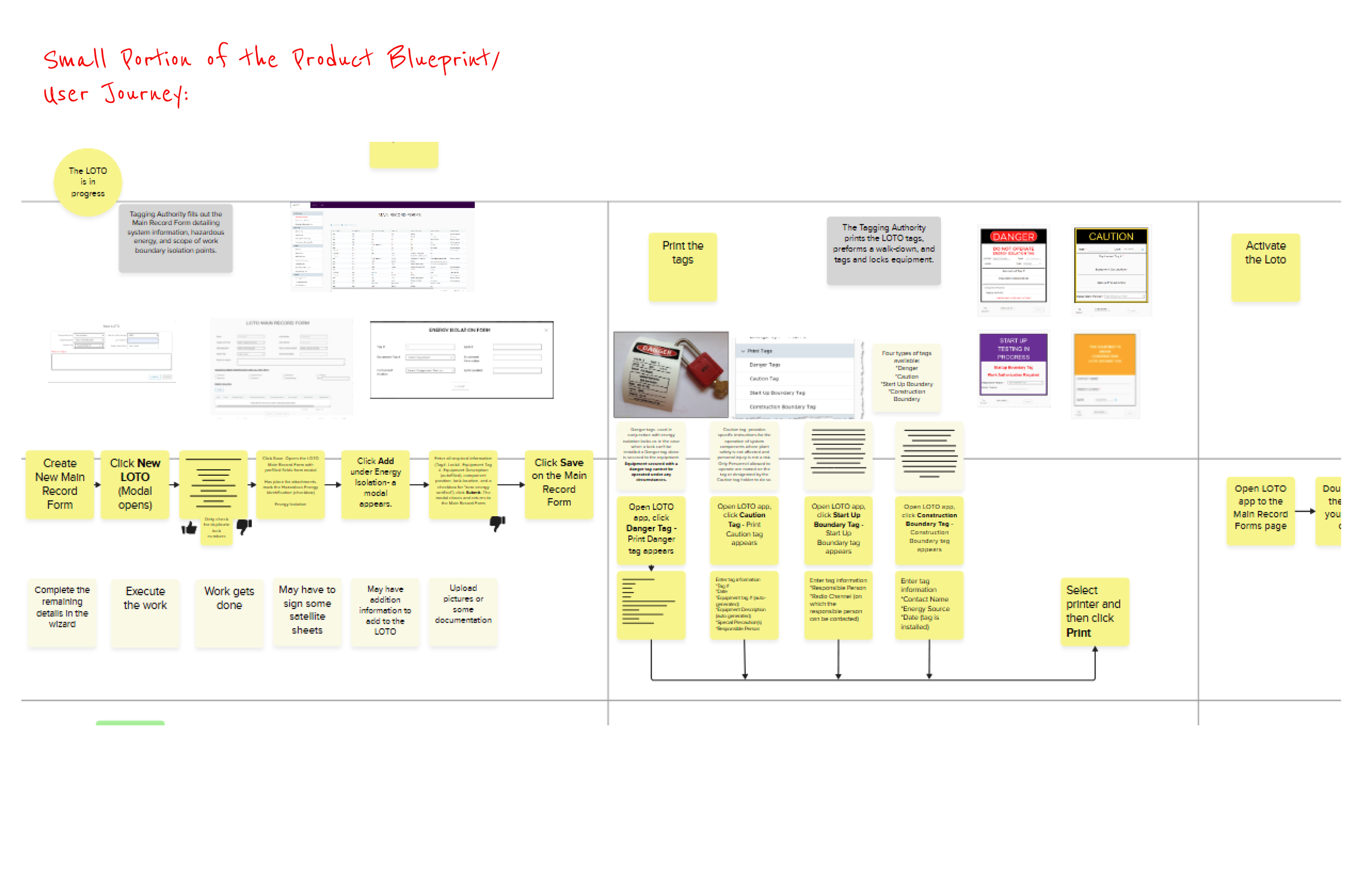
Visualizing Complexity: Process Mapping
Methodology: Developed a detailed process map visualizing the LOTO user journey from order placement through invoice approval, explicitly highlighting manual handoffs, repetitive tasks, and communication points.
Insight: The map revealed a highly complex, multi-step workflow with frequent temporary lifts, permit revalidation, and client coordination—pinpointing specific areas ripe for digital optimization. This served as a crucial blueprint for the proposed solution's functionality.
Blueprinting the Solution: Research-Informed Features
Methodology: Based on identified pain points and workflow complexities, I collaborated closely with stakeholders and the designer to define core features of the digital solution.
Key Design Principles:
Mobile-First Design: Essential for on-site LOTO specialists
Centralized Notifications: Streamline communication during dynamic events like temporary lifts
Offline Functionality: Critical for areas with limited connectivity on large construction sites
Proposed Features:
Digital Permits & Forms: Replace paper with easy-to-fill, trackable digital forms with templates
Streamlined Temporary Lift Workflow: Automated authorization, digital checklists, instant notifications
Real-Time Notifications: Automated alerts for key actions (permit approvals, status changes) via multiple channels
Centralized Documentation: Single source of truth for all LOTO-related records, improving searchability and audit readiness
Training Modules: Built-in resources to ensure user understanding and compliance tracking
Validation & Testing
Usability Testing with LOTO Specialists
Methodology: Recruited five LOTO specialists for first-round usability testing on a high-fidelity prototype. Observed how users interacted with digital flows, specifically around permit creation, temporary lifts, and navigation.
Uncovering Critical Pain Points
Quantitative Findings:
80% of users struggled with navigation and unclear button functionality
60% found field labels confusing or redundant
100% requested automation features to reduce manual effort
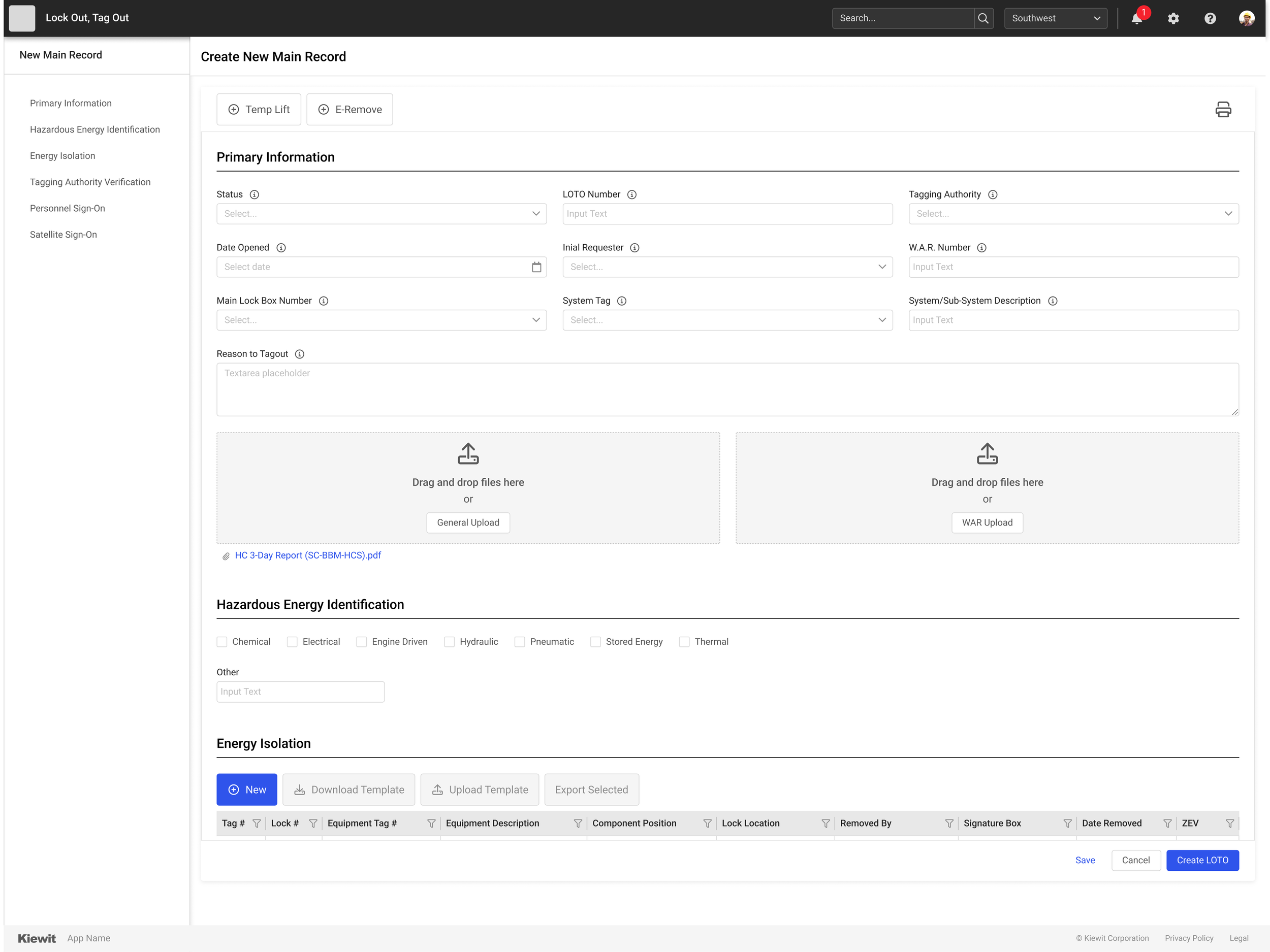
6 distinct pain points identified in the Temporary Lift form (cited as most frustrating workflow)
Qualitative Findings & Recommendations:
1. Confusing Navigation & Workflow
Problem: Users struggled to find forms (e.g., temporary lifts, E-Remove) and understand process steps
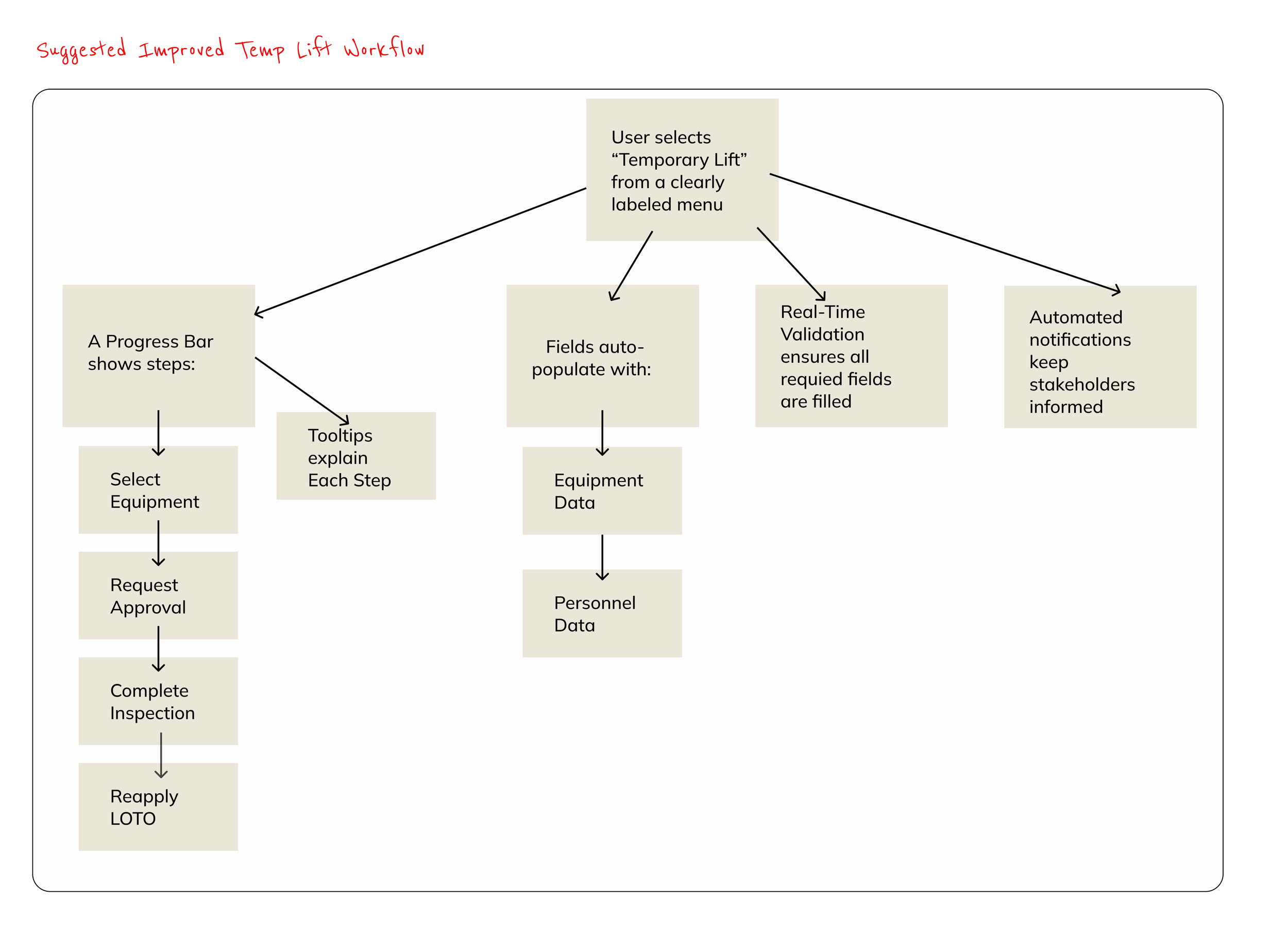
Recommendation: Implement clear, hierarchical menus, breadcrumb trails, progress indicators, and guided workflows for complex actions
User Quote:"There's a lot of info on here... I'm not sure what you would name it, but it'd be like a lot of overview of everything 'cause this content engine here is like showing everything." — User #3
2. Unclear Terminology & Field Labels
Problem: Jargon, inconsistent terms, and redundant fields caused confusion
Recommendation: Use simplified, consistent language, tooltips, examples, and conditional logic to reduce cognitive load
3. Lack of Automation & Data Validation
Problem: Users desired less manual effort and more error prevention
Recommendation: Implement auto-population, real-time validation, and automated notifications/approvals for key actions
User Quote:"If there's a way... instead of dragging and dropping the work authorization sheet, if there was a way to search for the work authorization number and then have that work authorization system automatically upload that sheet just by entering in the number." — User #5
Iteration & Impact
Implementing Research Insights
Based on critical feedback from usability testing, the digital prototype was iteratively refined, significantly improving the Temporary Lift workflow.
Key Improvements:
Reduced cognitive load through simplified navigation and terminology
Improved efficiency via automation and real-time validation
Enhanced clarity with visual cues and contextual help
Measurable Outcomes:
User Interviews: 6 conducted to define initial problems
Usability Tests: 5 completed in first round (with 3 more planned)
Efficiency Gain: 30% increase in permit handling efficiency
Cost Savings: Estimated $300K saved annually in fines, administrative costs, and avoided downtime
Key Learnings
Safety-Critical Design Requires Different Standards: In high-stakes environments, efficiency can't come at the cost of safety. Every design decision required validation that it wouldn't introduce new failure modes or compliance risks. Research wasn't just about making the system faster—it was about making it safer and more reliable under pressure.
User-Centered Design Builds Trust in Regulated Environments: LOTO specialists initially resisted digitization, fearing technology would add complexity to an already critical process. By involving them deeply in research and testing, we built trust that the solution was designed for their needs, not imposed on them. This stakeholder alignment was crucial for adoption.
Iteration is Essential in Safety Systems: Usability testing revealed issues that could have created compliance gaps (80% struggled with navigation, 60% found labels confusing). Addressing these through iterative refinement before launch prevented potential safety incidents that would have undermined the entire digitization effort.
Project Reflection
This project was a rewarding challenge, underscoring the critical balance of safety, efficiency, and user needs in a high-stakes environment. Our research revealed how even small design decisions, when informed by user feedback, could significantly impact user satisfaction and operational efficiency.
Key Learnings:
User-Centered Design: Essential for driving satisfaction and efficiency in safety-critical environments
Stakeholder Alignment: Crucial for project success and gaining support for research initiatives
Uncompromising Safety: Maintaining strict adherence to regulatory standards while innovating
Change Management: Recognizing the need for clear communication, training, and support for adoption
Next Steps
While the digital LOTO system has shown significant promise, its foundation supports further impactful enhancements:
Pilot Program: Launching on a live construction site for real-world validation
Enhanced Integration: Exploring deeper integration with IoT devices and equipment monitoring for automated verification
Advanced Analytics: Developing dashboards for insights into LOTO trends and bottlenecks
Scalable Training: Expanding interactive training modules for improved user engagement and knowledge retention
Continuous Iteration: Consistently gathering feedback post-launch to ensure the system evolves with changing needs
Global Compliance: Adapting the system for international LOTO regulations
This digitalization represents a significant step forward, empowering LOTO specialists and setting a new standard for safety and efficiency in the construction industry through robust, user-centered research.