
Commodity Management System — UX Research, Kiewit Technology Group
End-to-end research study identifying workflow inefficiencies in an enterprise commodity management system. Findings drove a 70% reduction in manual data entry and $5.7M in projected annual savings.
Freeing engineers from spreadsheets to focus on what they do best
Engineers managing construction materials across multiple projects face decision fatigue when tracking hundreds of commodity codes while balancing budget constraints and timeline pressures. How do we reduce cognitive load in data-heavy workflows while maintaining accuracy?
Behavioral Challenge
Conducted workflow analysis and user interviews with engineers and procurement teams to understand mental models, pain points in spreadsheet-based systems, and decision-making patterns under time pressure.
Research Approach
Managing complex data sets, reducing manual entry errors, streamlining multi-stakeholder workflows- these are patterns that appear across industries from supply chain management to financial reconciliation.
Transferable Insights
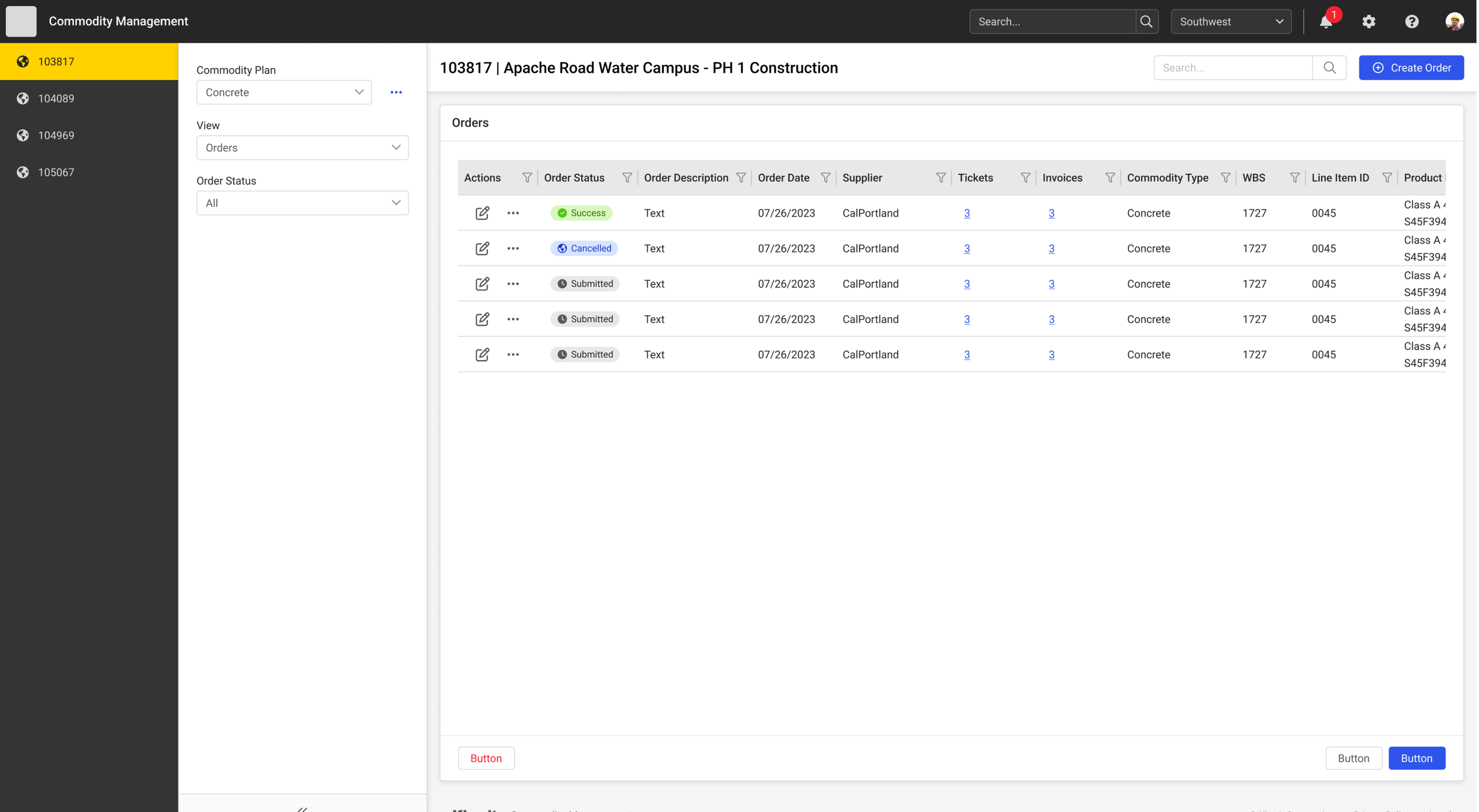
The Goal: A digital transformation of Kiewit's commodity materials tracking system, replacing manual, error-prone processes with a streamlined, automated solution that tracks materials from order to invoice.
My Role: Lead UX Researcher—conducted end-to-end research from discovery through solution validation. Designed and executed user interviews with 11 field engineers and procurement teams, facilitated requirements workshops with cross-functional stakeholders, mapped complex workflows to identify inefficiencies, and translated research findings into specific product requirements that informed the automated solution. Advocated for user needs throughout the product development process."
Key Outcome: Research-driven solution projected to save $4.9 million annually and free up to 10 hours per week per Project Engineer (29,625 hours saved company-wide annually)
Project Snapshot
💡 Research Impact
Without deep workflow research, this project could have automated the wrong processes—or worse, added new friction. User interviews and process mapping revealed that engineers spent 10-20 hours weekly on manual data entry instead of engineering—a hidden cost the business hadn't fully quantified. This research directly informed which processes to automate first, resulting in $5.7M in projected savings and nearly 30,000 hours freed up annually.
Industry: Construction / Enterprise Resource Planning (ERP) / Financial Management
Challenge: Overcome manual, error-prone tracking of construction materials from order to invoice
Team: Lead UX Researcher (Me), Stakeholders (District & Project Engineers), Designer, Programmers, Project Manager, Product Owner
Constraints: Constant project restructuring, stakeholder delays, technical integration challenges, complex accounting requirements
The Solution
A Smarter Commodity Management System
Our solution leveraged modern technology to bypass manual inputs, creating a unified platform for comprehensive commodity management.
Goals:
Automate Data Capture: Eliminate manual entry of delivery tickets
Ensure Accuracy: Automatically verify tickets against orders and invoices, flagging discrepancies
Provide Robust Accounting: Accurately track complex accounting codes (WBSs) and multiple tax situations
Boost Productivity: Free up Project Engineers for higher-value tasks
Discovery: Understanding User Pain Points
Methodology: Conducted user interviews with 11 key participants, including District and Project Engineers—the primary users of the existing system.
Key Research Insights (3 Major Challenges):
1. Time-Consuming
Engineers spent nearly a full week setting up trackers for each project
10-20 hours weekly on manual ticket input
Time diverted from core engineering responsibilities
2. Error-Prone
Manual inputs were a significant source of errors
Lost physical tickets compounded accuracy issues
Vendors' reluctance to add data further complicated the process
3. Accounting Complexities
Existing systems struggled with multi-part accounting codes (Split WBSs)
Varied tax situations (e.g., non-taxable permanent materials) led to reconciliation issues
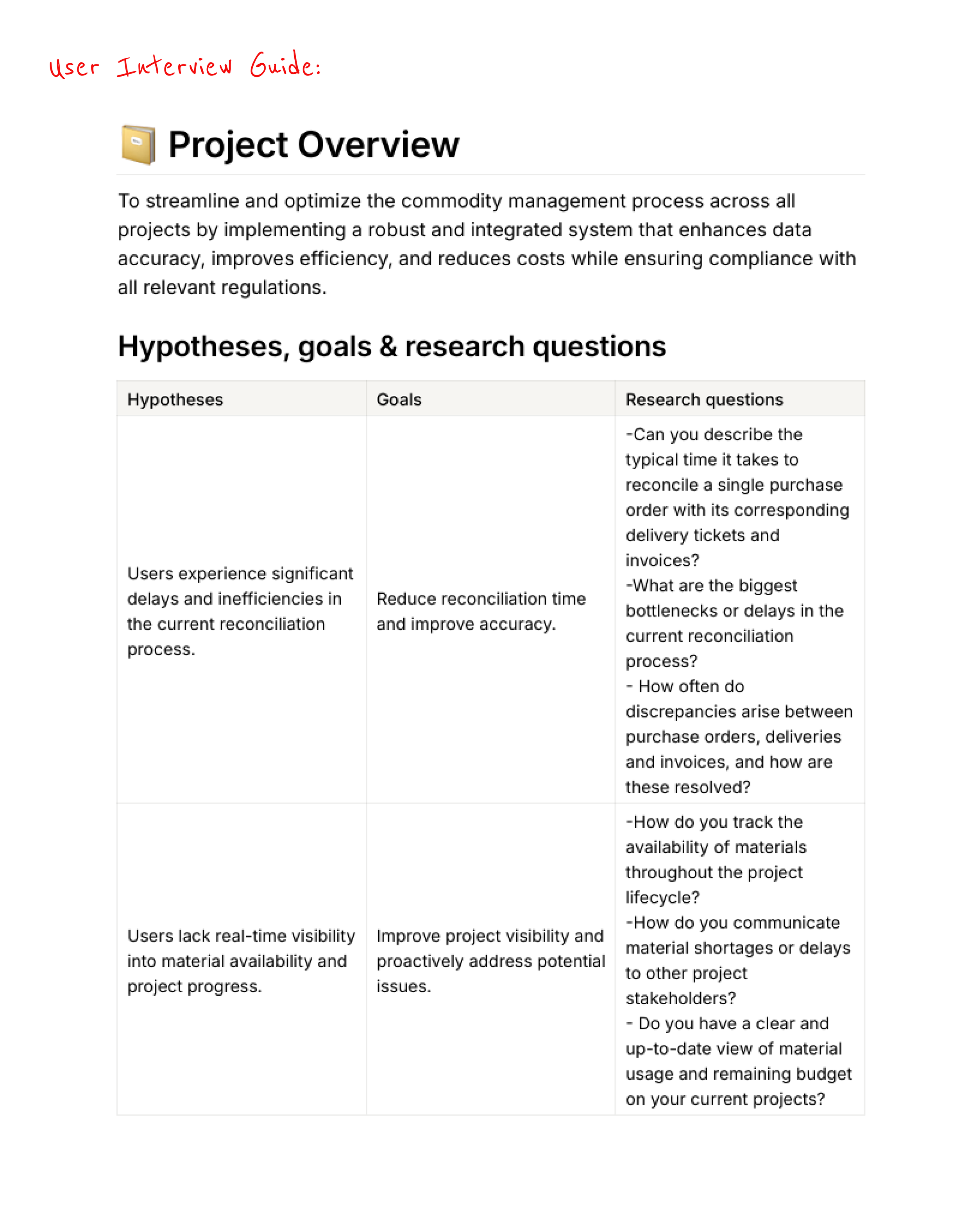
Visualizing Current Workflows: Process Mapping
Methodology: Developed a detailed process map visualizing the entire user journey from order placement to invoice approval.
Insight: The map clearly highlighted numerous manual handoffs, repetitive data entry, and potential error points in the existing process—making a compelling case for digitalization and serving as a critical tool for identifying specific areas for improvement.
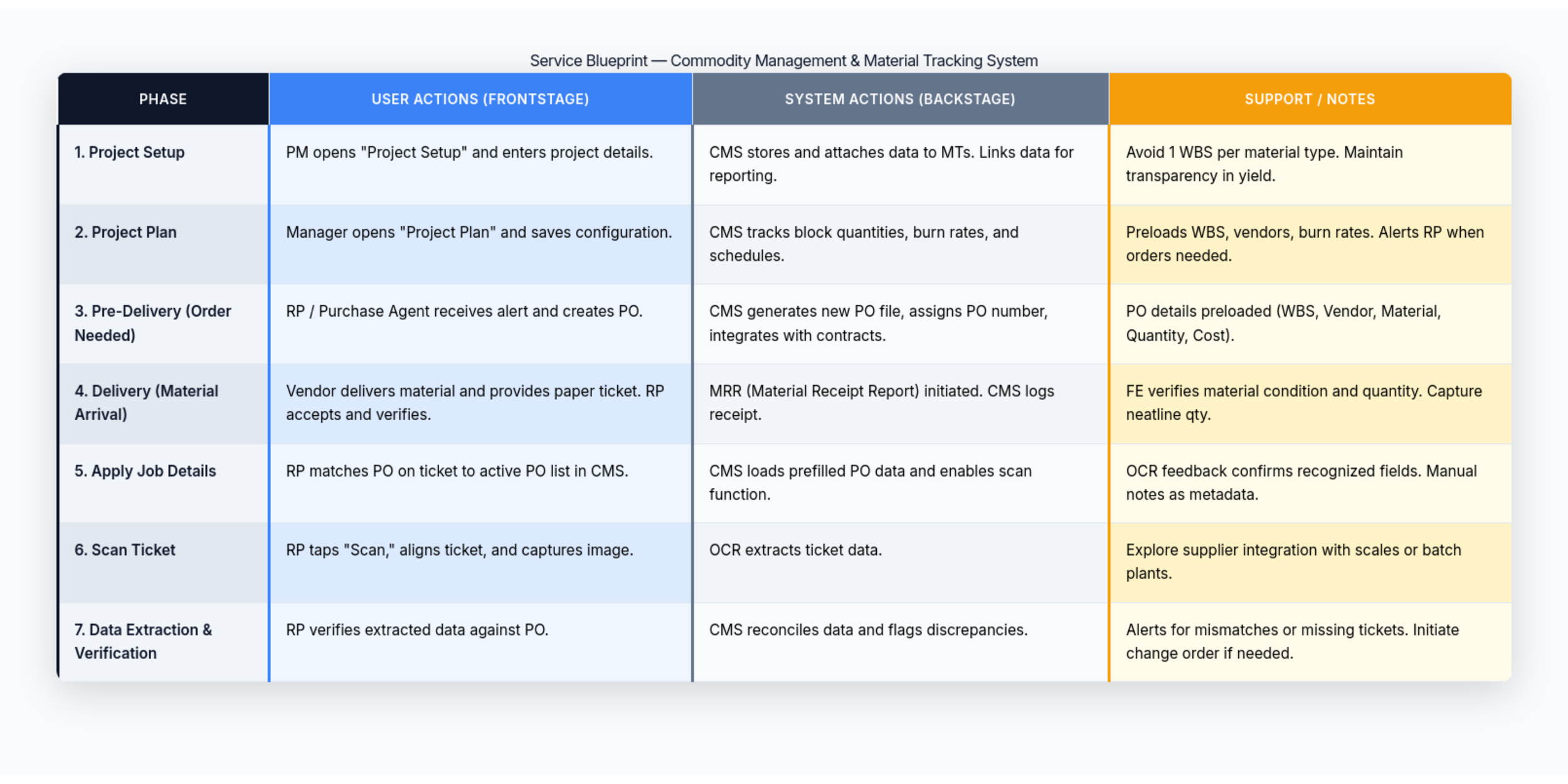
Building Consensus & Prioritizing: Requirements Workshop
Methodology: Facilitated a requirements workshop with key stakeholders, including District and Project Engineers and leadership.
Insight: This collaborative session was crucial for prioritizing features based on direct user needs and business objectives, and for securing essential stakeholder buy-in. The workshop refined the product vision, ensuring alignment and a clear path forward.
Key Insights Informing the Product Blueprint:
System Consolidation: A unified platform was necessary to streamline fragmented processes
Real-Time Visibility: Users needed instant access to material status and delivery timelines
Simplified Approvals: The existing approval workflow needed significant streamlining to reduce delays
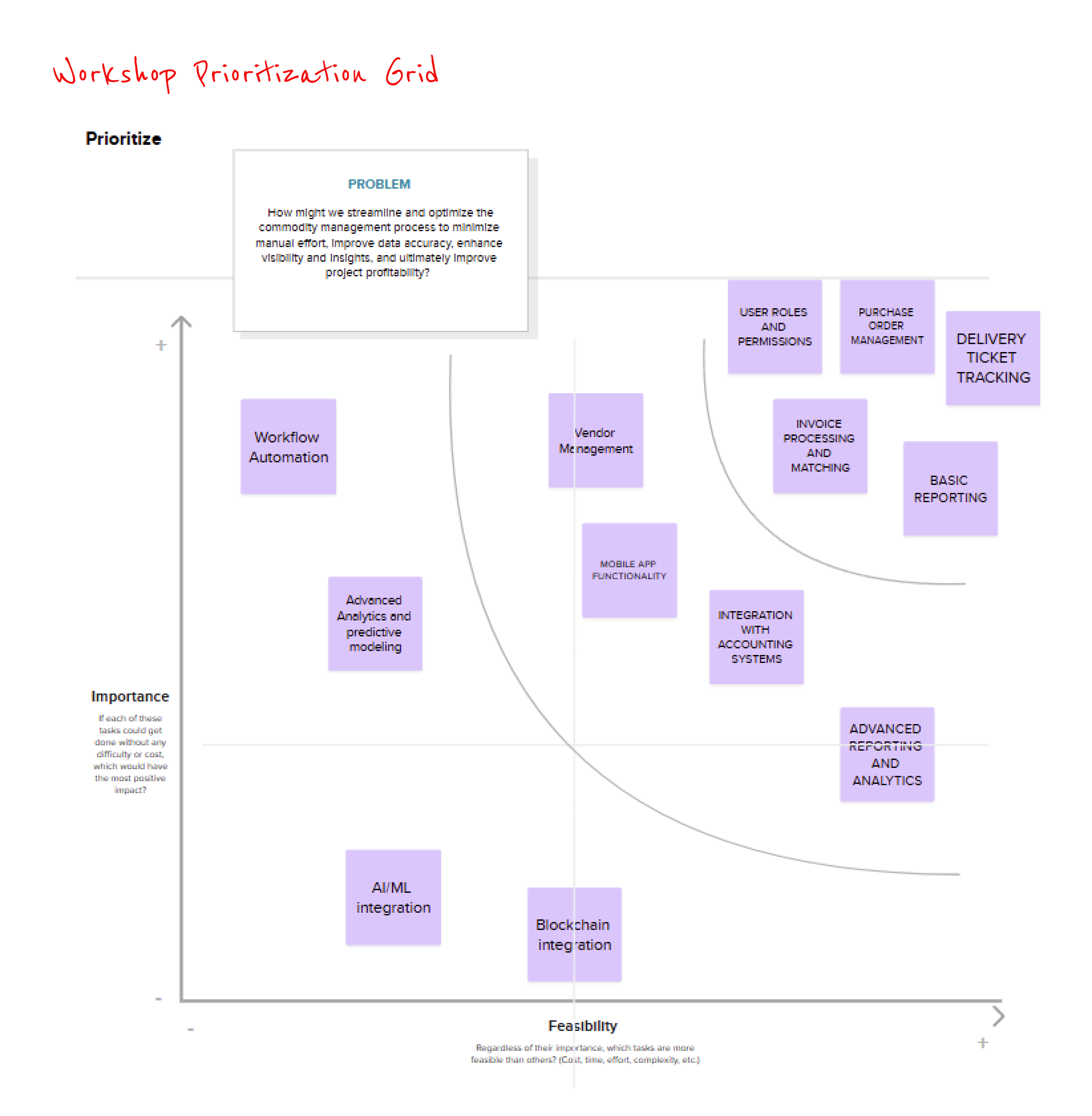
Research Recommendations:
Leveraging Automation for Impact
Our research directly informed the integration of modern technology to address identified pain points and deliver significant efficiencies.
1. Automating Data Capture & Verification
OCR Scanning Technology
Implemented Optical Character Recognition (OCR) to digitize handwritten delivery tickets
Eliminated manual data entry—identified by users as a major time sink and error source
Automated Verification
System automatically compares delivery tickets against orders and invoices
Proactively notifies field engineers of discrepancies—a direct solution to the "error-prone" challenge
Discrepancies must be resolved before payment, ensuring financial accuracy
2. Robust Accounting & Reporting
Complex Accounting Handling
System engineered to robustly manage multiple cost centers (Split WBSs) and diverse tax codes
Addressed a critical challenge highlighted in user interviews that previous automated systems struggled with
Enhanced Reporting
Tracks orders, tickets, and invoices against contractual amounts
Provides robust reporting on inventory levels, accumulated costs, and remaining contract allotments
Enables more accurate forecasting and decision-making
“Lots of engineers don’t like doing that kind of work... they’ll get frustrated and want to do something else because they didn’t... go to school to be an admin and punch tickets and look at spreadsheets.”
Projected Impact
Note: Due to organizational restructuring, I was unable to see this project through to launch. The outcomes below represent projected savings based on our research findings and stakeholder validation.
Projected Annual Savings:
Total Cost Savings: $46.9 million annually through process automation and efficiency improvements
Overpayment Reduction: $45.9 million reduction in overpayments
Time Savings (Per Engineer): Up to 592.5 hours per year freed per Project Engineer for higher-value tasks
Time Savings (Company-Wide): 29,625 hours saved across the company annually
Research Metrics:
User Interviews: 11 participants to uncover deep pain points
Workshops: 1 requirements workshop to prioritize and align stakeholders
Key Learnings
This project highlighted the power of UX research to drive tangible business value in complex enterprise environments.
What I Learned:
Collaboration Drives Success: Facilitating workshops and securing stakeholder buy-in was crucial for consensus and project vision alignment
Technology as an Enabler: Leveraging tools like OCR and automation directly addressed core inefficiencies identified in research, leading to projected immense time and cost savings
Iteration is Essential: Addressing complex technical challenges (like diverse accounting requirements) reinforced the value of iterative research and design
Quantifying Impact: Seeing the projected financial and time savings underscored how streamlining processes, informed by user understanding, can lead to measurable, transformative organizational impact
Advocating for Voice of Customer Pays Dividends: During discovery, field engineers consistently mentioned trucking materials as a critical pain point. I advocated for including trucking in scope, but stakeholders decided to descope it to meet launch timelines. During development, persistent user feedback forced the team to add trucking support back in—resulting in costly rework that delayed the original launch timeline. This validated what the research had shown from the start. The cost of addressing user needs early is almost always lower than the cost of rework mid-development. Research isn't just about uncovering insights; it's about advocating for those insights even when priorities conflict.
Planned Next Steps
While organizational changes prevented me from seeing this project through to completion, the research foundation I established supported these planned enhancements:
Usability Testing: Evaluate system intuitiveness and identify areas for UX improvement
Field Observations: Observe users in their natural environment to uncover hidden inefficiencies
Expanded Automation: Explore further opportunities for automation, including third-party system integrations
Enhanced Analytics: Develop robust dashboards for actionable insights, forecasting, and decision-making
Scale & Training: Roll out the solution to more teams with comprehensive training for smooth adoption
This project demonstrated how aligning technology with deep user needs through rigorous research creates the foundation for measurable, impactful outcomes in enterprise environments.